Catsdogs


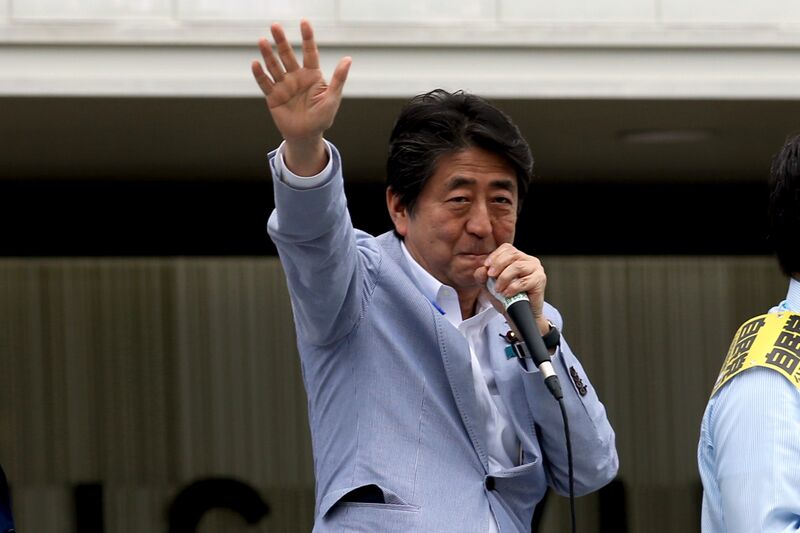
Shinzo Abe campaigning in Kobe.


Japan’s long-ruling Liberal Democratic Party is heading into Sunday’s upper house election burdened with an unpopular sales tax hike plan, a divisive bid to change the pacifist constitution and a black mark for fueling public unease over the pension system.
It’s expected to win hands down.
The country’s fragmented opposition has consistently failed to take advantage of cabinet scandals, gaffes and a security agenda that has sometimes sparked voter anger. As a result, almost seven years after Prime Minister Shinzo Abe returned to office, he is set to win his sixth straight national election victory and become the country’s longest-serving premier come November.
It’s a phenomenon that has even some members of the LDP lamenting the lack of competition. “Even though we’re going into the election calling for a tax increase, the LDP is in pretty good shape. This is incomprehensible,” said Shigeharu Aoyama, an upper house lawmaker from the ruling party. “It’s not healthy at all.”
Opposition parties are campaigning on popular pocketbook issues they say will ensure financial stability for families, trying to capitalize on public support for canceling Abe’s planned October sales tax increase. Abe is promising stability, strength and the status quo, which seems to be a winning formula.
The LDP-led block is expected to take at least 70 of the 124 upper house seats up for grabs, a Kyodo News pollreleased this week showed. The party has controlled the lower house, and thus the government, for all but four of the past 64 years.
“There are various parties in opposition now, but they can’t present a unified front,” said Mieko Nakabayashi, a former lawmaker with the Democratic Party of Japan, which a decade ago was the last opposition group to seize power from the LDP. “That means it’s hard for them to win elections. The public doesn’t look at this favorably,” said the lawmaker turned politics professor at Waseda University.
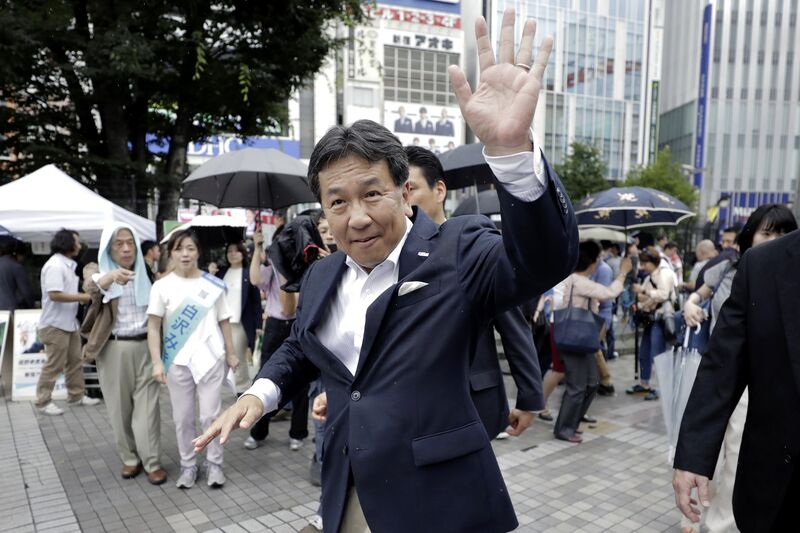


Constitutional Democratic Party of Japan Head Yukio Edano Speaks At Campaigning Event

For example, voters in Tokyo will not only have a choice between the LDP, its coalition partner Komeito and the two halves of the former DPJ -- the Constitutional Democratic Party and the Democratic Party for the People -- but a total of 20 candidates from about a dozen different parties and groups.

Changing Times

Back in 2009, the DPJ ejected an LDP that voters saw as out of touch, sparking hopes that a two-party system could take root. But the government’s support rate tumbled to about 13% after the 2011 earthquake, tsunami and nuclear disaster that left about 20,000 people dead or missing, with reasons cited by respondents being distrust of its statements on the nuclear crisis and the party’s political infighting.
crushing election defeat in 2012 stopped the Democrats’ advance and they were returned to the political wilderness, where they’ve remained ever since. To make matters worse, a 2017 attempt to oust Abe by Tokyo Governor Yuriko Koike ended up splitting the DPJ into two parties that have shown no sign of reunifying.
Meanwhile, a buoyant jobs market has helped shield Abe from complaints about his administration, which has been able to end a deflationary spiral in the world’s third-largest economy through unprecedentedmonetary easing and government spending. He’s also managed to maintain the LDP’s traditional close relations with the U.S. -- Japan’s sole security guarantor -- despite occasional criticism from President Donald Trump.
Asked which party they supported, 45% of respondents to a poll carried out by the Asahi newspaper July 13-14 said they didn’t know or didn’t favor any. While the LDP had 34% support, no other party scored more than 6%.
“If the LDP wins every time, there will be no checks on it,” said Yu Uchiyama, a professor of politics at the University of Tokyo. The remnants of the DPJ “should work together to oppose the LDP,” he added.

Faltering Fortunes

The career of Kuniko Koda, who won election to the upper house as a member of the then-rapidly rising opposition DPJ in 2007, traces the party’s faltering fortunes. She left the DPJ before its defeat in 2012 and later joined Koike’s Party of Hope.
This month, she is leaving national politics in favor of a campaign to become governor of Saitama prefecture, bordering Tokyo. She will be running as an independent. Koda said DPJ leaders lacked a determination to keep the party in power and failed to take responsibility for their mistakes by handing over to a new generation.
“We need another major party that can take over from the LDP as the party of government,” Koda said in an interview at her campaign office in Saitama. “The diplomacy and national security policies should be the same, but it should be capable of quick reforms to meet the needs of the time.”
While an upper house election doesn’t lead to a change in regime, an opposition majority can delay the government’s agenda. The main question for Abe this Sunday is whether he can win the two-thirds’ majority needed to order a national referendum on his plan to revise the pacifist constitution.
That such a milestone is within reach is a sign of how voters are opting for stability. Abe has prided himself on managing the economy, but even the prospect of a downturn is unlikely to convince voters to switch allegiance, said Nakabayashi, the former DPJ lawmaker.
“If the voters become dissatisfied with the administration, the only other option is the opposition parties. But they are not showing they have the capacity to run the government,” she said. “Voters feel nothing good will come from having the opposition take over.”

Japan Is a One-Party State Again And Voters Are Fine With That


Not all voice assistants can handle the same requests. We put Siri, Alexa and Google to the test.

As privacy concerns loom large over smart speakers, a new investigation has found that Google's smart speakers might infringe on individual privacy more than buyers realize.

Even when Google Home smart speakers aren't activated, the speakers are eavesdropping closely, often to private, intimate conversations, a report by Dutch broadcaster VRThas uncovered.
 Recordings found by VRT contain startling content: Couples' quarrels that may have potentially resulted in domestic violence, explicit conversations in the bedroom, men searching for pornography, confidential business calls, and talks with children.
How does the technology work? The commands to activate Google Home speakers are "Hey, Google" and "OK, Google." Once anyone says something that resembles those commands, Google Home starts to record.The recordings are then sent to Google subcontractors, who review them later to aid Google in understanding how different languages are spoken. 
There are no policies in place, found VRT, if a subcontractor finds a recording of an individual in danger.
A Google spokesperson told USA TODAY that Google Assistant users must opt in to have their voice recordings stored on their account, and that users can still use their Google Home products without enabling the setting. 
Google adds that it only reviews 0.2% of audio recordings for transcription.
Google does, however, require users to turn on voice recording in order to use all of Google Home's features.

A confusing 'maze':Amazon secretly recording and storing what your kids say, complaint says
Enough information is revealed in these recordings to gather sensitive details, like individual addresses. 
The whistleblower who reached out to VRT was a Dutch subcontractor hired to transcribe recorded audio for Google to use in its speech recognition technology. He reached out after discovering that Amazon's Alexa, a direct competitor to Google Home, keeps its data indefinitely.
Google said in a statement that it is investigating the whistleblower "to prevent misconduct like this from happening again."  
This reports contradicts what Google states in its"commitment to privacy in the home."
"Your device will only send audio to Google if we detect that you or someone in your home is interacting with your Assistant ...  or if you use a feature that needs it," writes the company. "You can always turn the microphone off."

Source : https://www.usatoday.com/

Google workers are eavesdropping on your private conversations via its smart speakers


US President Donald Trump Says He’s ‘Not a Fan’ of Bitcoin


Donald J. Trump tweeted Thursday that he is “not a fan” of cryptocurrencies, saying they were “not money” and referencing their price volatility relative to the dollar in his first public comments on crypto since becoming president of the United States.
Trump also criticized Facebook’s Libra cryptocurrency project in subsequent tweets, saying it “will have little standing or dependability” and suggesting U.S. regulators would subject the social media giant to regulation:

“If Facebook and other companies want to become a bank, they must seek a new Banking Charter and become subject to all Banking Regulations, just like other Banks, both National […] and International.”
(Facebook subsidiary Calibra, which is supposed to develop an open-source wallet for the cryptocurrency, has registered as a money services business with the Financial Crimes Enforcement Network.)
Trump has criticized Facebookin the past for its actions in banning right-wing figureheads, alongside other social media outlets. To date, however, he has not discussed Facebook’s cryptocurrency plans. The company first publicly released its white paper and supporting documentation for Libra last month.

The 45th president held a “social media summit” earlier on Thursday, addressing these concerns.
Regulators and lawmakers across the U.S. have taken notice of Libra, with both the U.S. Senate Banking Committee and the House Financial Services Committee scheduling hearings next week with Facebook’s blockchain lead David Marcus.
The Senate committee in particular has previously expressed concerns about Facebook’s track record with user data and privacy, writing an open letter to the company in May. Marcus responded to the letter earlier this week, telling the lawmakers that Facebook would not itself collect any personal financial credentials.
On Wednesday, Federal Reserve Chairman Jerome Powell also said that Libra should not be allowed to move forward unless and until the company addresses anti-money laundering and know-your-customer concerns, among other issues.
Financial stability is also a factor that Powell addressed, with lawmakers in both houses questioning the fact that Facebook has set up an entity in Switzerland affiliated with the project.

Facebook declined to comment on Trump’s comments.

‘Unlawful behavior’

In his tweets Thursday, Trump took aim at the potential for using cryptocurrencies in illegal activities, citing drug trafficking in particular.
“Unregulated Crypto Assets can facilitate unlawful behavior, including drug trade and other illegal activity,” he said.
In a final tweet, he added:
“We have only one real currency in the USA, and it is stronger than ever, both dependable and reliable. It is by far the most dominant currency anywhere in the World, and it will always stay that way. It is called the United States Dollar!”

While Trump himself had yet to weigh in on cryptocurrencies prior to Thursday, his Treasury Secretary has been a strong proponent of greater cryptocurrency regulations.
Steven Mnuchin has been calling for greater crypto regulation since the beginning of 2018, calling on the G20 to take up the issue during an (at the time) upcoming meeting in March.
This year, the Financial Action Task Force published guidance for central banks, calling for stringent know-your-customer information collection practices. The U.S. Treasury Department held the FATF presidency until the end of June.
“We will not allow cryptocurrency to become the equivalent of secret numbered accounts [and] we will allow for proper use, but we will not tolerate the continued use for illicit activities,” Mnuchin said in remarks prior to the rules’ publication.
In contrast, acting White House Chief of Staff Mick Mulvaney has previously called for a more lenient regulatory framework, saying, “if we over-regulate and discourage people from entering the marketplace, that has bad consequences.”

Source :  https://www.coindesk.com/

US President Donald Trump Says He’s ‘Not a Fan’ of Bitcoin